10 years of the NTI NeuroNet Recreation Center: from hypotheses to a sustainable industry and technological independence in Russia
«NeuroNet is not just a field of science, but a full-fledged industry, where human-machine interaction technologies become the basis for new products and services. Confidence in the future requires not only innovation, but also responsible implementation, competent risk management, and active support for universities and entrepreneurs.»
Andrey Ivashchenko, Leader of the NTI NeuroNet Working Group, Chairman of the Board of Directors of the ChemRar Group
On December 24, 2025, atthe Neurotech platform, industry leaders, leading experts-scientists and practitioners-summed up the events of 2025 and the entire decade, discussed initiatives to update the roadmap and prospects for the NeuroNet market in Russia.
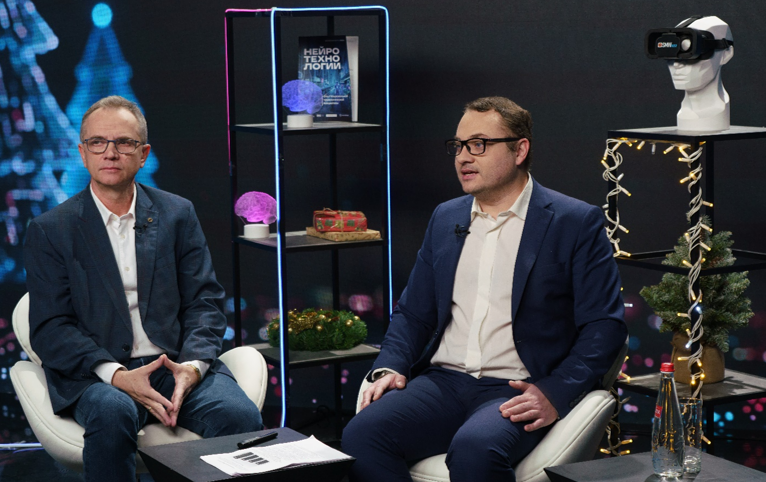
The event was opened by Andrey Ivashchenko, leader of the NeuroNet Group of the National Technology Initiative( NTI), Chairman of the Board of Directors of ChemRar Group, Doctor of Technical Sciences, Professor of the Russian Academy of Sciences. In his speech, he spoke about the main results of NeuroNet’s work from 2015 to 2025.
Over the past 10 years, the neural network has evolved from a research area to a large-scale industrial ecosystem that unites academic, educational institutions, startups, government programs, and private investment. This progress is due to two synergistic areas: biotechnological approaches to neuroscience and the widespread use of information technologies in the context of the human brain and the interaction of people with computers. At their intersection, six key segments of neurotechnology emerged, which were identified at the very beginning in 2015 as priority: Neuropharma and Neurotechnology, as well as Neuroeducation, Neuro-entertainment and Sports, Neuro-communications and Neuroassistents.
The focus in these segments is not only on medical solutions, but also on the impact of technology on everyday life. Neuroeducation, Neuroassistents, and Neurotransmissions also play a leading role in predicting the future — they are becoming the field where artificial intelligence and big data processing enhance human functionality and provide the greatest added value. At the same time, neuro–entertainment and sports remain promising in the context of mass adoption of neuro-communications and brain-computer feedback, which underlines the importance of a multidisciplinary ecosystem that unites education, culture and industry. Neuromedicine and Neuropharma, aimed at improving the quality of life of patients, play an important role, which demonstrates the wide range of applications of brain technologies and emphasizes the humanitarian mission of NEURONET.
Over the past 10 years of NeuroNet hundreds of small businesses and dozens of large companies have sprung up in key segments of the neural network, some of which went public and went public, which helped strengthen the financial stability and investment potential of the neurotechnology market and increase public confidence in new technologies. The development of the network of educational and research circles «young neuro-modeller» throughout the country served as a kind of bridge from the school bench to university laboratories and the entrepreneurial sector and allowed us to build a systematic link between education, innovation and business.
The development of the industry was based not only on technological innovations, but also on the improvement of institutional mechanisms – state, including regulatory support, and infrastructure development. We have created accelerators, startup support funds, and research project financing that have helped turn ideas into products and bring them to domestic and foreign markets. In this sense, the Neural Network repeats successful cases in the field of IT technologies, where a systematic approach to education, research and entrepreneurship has become the key to Russia’s competitiveness and technological leadership in the global market.
Важной частью будущего Infrastructure development remains an important part of the future of the neural network: strengthening venture funds and government tools to accelerate the transition from scientific results to industrial implementation and ensure sustainable growth of the sector even against the backdrop of rapidly changing technologies and market conditions.
«After 2022 and the introduction of sanctions against Russia, the need to develop our own technologies became obvious to everyone. The main problem now is the weak market for venture capital investments, especially in diptech and biotech, including neural network technologies. Due to large checks and long payback periods, such projects are not funded by private investors, which creates a «valley of death» between science and industry. To overcome this, it is proposed to restart the system of venture funds — private, public and university-with the participation of state development institutions, such as VEB, to ensure the transition of technologies from laboratories to industry, despite the high cost of money and economic risks,» said Andrey Ivashchenko.
The expert estimates that the forecast for the future includes further expansion of the number of market segments and deeper integration into rehabilitation, education, sports and marketing. Neuroeducation and Neuroassistents will go hand in hand with the development of AI and analytical platforms, allowing you to create personalized educational routes, adaptive interfaces, and new services for businesses and consumers.
In conclusion of his speech, Andrey Ivashchenko noted: «I sincerely believe that technologization in the fieldof Neuronet directionsfor the next 10 years will be a key element of technological sovereignty and technological leadership in the world. And Russia, of course, should be in the lead here, because all the prerequisites for this are there.»